Where to Take a Weaving Class Near Peguche
If you are looking for a hands-on weaving class near Cascada de Peguche or Otavalo, the closest serious options are in Peguche village and the neighboring Agato community. These are not classroom-style tourist studios with fixed hourly schedules. Most are family-run artisan workshops where visitors can watch wool carding, spinning, natural dyeing, and loom work, then arrange a practical lesson if the weavers are available that day.
The most specialized option is the Tahuantinsuyo Weaving Workshop in Agato, about 2 kilometers uphill from the waterfall area. It is best suited for travelers who want to learn traditional backstrap loom techniques rather than simply buy finished textiles. Short demonstrations are often available for a voluntary donation, while a deeper backstrap weaving class has historically cost about $25 per day. Bring cash in small bills, allow at least half a day, and avoid arriving late in the afternoon.
- Best base: Otavalo, located about 3.3 to 4 kilometers from Peguche.
- Closest waterfall-area workshops: Peguche Wasi and Artesanía El Gran Cóndor, both practical for demonstrations and direct artisan purchases.
- Best for a serious class: Tahuantinsuyo Weaving Workshop in Agato, reached by walking uphill from Peguche or by local transport.
- Budget tip: Demonstrations may be free, but a donation or direct purchase is expected and supports the artisan family more directly than buying in Otavalo’s Plaza de Ponchos.
- Timing tip: Go in the morning, especially on weekdays. During the June Inti Raymi period, production schedules can pause for community celebrations and purification rituals at the waterfall.
The Historical Roots of Peguche’s Textile Tradition
The Founding of Obraje de Peguche in 1613
The Fakcha Llaqta community maintains a centuries-old connection to textile manufacturing that defines the economic reality of the region today. Established in 1613, the Obraje de Peguche positioned the area immediately surrounding the famous waterfall as a high-production industrial hub centuries before it developed into a recognized tourist destination. This specific historical site laid the foundational groundwork for the weaving mastery seen throughout the Otavalo region in the modern era, transforming the local population into generational experts in wool processing and loom operation.
The Legacy of Spanish Forced Labor and Colored Paños
The origins of this craft carry a documented history of colonial exploitation. Historical records indicate that hundreds of indigenous people were forced by Spanish colonizers to work grueling hours in the obrajes (textile workshops). These laborers were tasked with weaving highly specific colored paños (cloth)—including deep blues, forest greens, purples, and reds—that were systematically exported across the Andes to fund the colonial enterprise. Over the subsequent centuries, the resilient community effectively reclaimed this painful history. The local population transitioned from indentured laborers to independent master artisans who deeply value their indigenous heritage. You can learn more about their ongoing cultural resilience in our Kichwa Culture & The Inti Raymi Festival guide.
Finding the Historical Marker at the Waterfall Entrance
When visiting the site, travelers can witness the physical evidence of this history firsthand. A permanent historical marker commemorating the exact location of the original Obraje de Peguche site sits right at the primary entrance to the waterfall. Reading this plaque provides essential context before walking the trails, framing the forest not just as a protected ecological zone, but as a site of immense historical labor. For exact details on entrance fees, operating hours, and navigating the main gate to find this marker, review our comprehensive Cascada de Peguche – Guide to Ecuador.
Preserving Pre-Inca Techniques at the Tahuantinsuyo Workshop
Located in the neighboring Agato community, the internationally recognized Tahuantinsuyo Weaving Workshop represents the pinnacle of traditional Andean textile arts. Reaching the workshop requires a 2-kilometer uphill walk on a cobblestone road directly from the Peguche waterfall, offering visitors a quiet route through the agricultural outskirts of the village. As of 2024, Tahuantinsuyo operates under the direction of its fourth generation of master weavers. The facility is currently managed by Jose Rafael Maldonado, the son-in-law of the late Miguel Andrango. Historical records note that Andrango was previously the only designated master weaver in all of South America, making this specific workshop a critical site for the preservation of ancestral knowledge.
Artisans at Tahuantinsuyo work exclusively on pre-Inca backstrap looms, known in the local Kichwa language as a callua. The physically demanding nature of this loom requires the weaver to use their own body weight to maintain thread tension. The facility also utilizes a unique manual walking wheel for hand-spinning yarn, which the family ingeniously constructed out of recycled bicycle parts to improve efficiency without sacrificing the handmade quality of the thread. Travelers interested in exploring these remote workshops alongside a knowledgeable local expert can arrange a guided Otavalo adventure exploring local crafts and culture, which frequently includes direct transportation to Agato.
Master weavers in the Peguche and Agato regions specialize in the traditional hand-spinning of raw alpaca and sheep’s wool, a meticulous process called Puchkana. Before the spinning can begin onto wooden drop spindles, the raw fleece is carded entirely by hand to remove debris and tangles. Following the spinning process, authentic workshops rely strictly on 100% natural, organic dyes. The artisans boil tocte (Andean walnut shells) for hours to extract rich, earthy browns, and harvest cochineal insects from local cactus plants to produce brilliant reds and purples. Visitors are welcome to tour the Tahuantinsuyo workshop for a voluntary donation, or they can book a hands-on, immersive backstrap weaving class to learn the ancient process for exactly $25 per day.
| Workshop / Artisan Center | Specialty | Demonstrations | Entry / Logistics |
|---|---|---|---|
| Taller Artesanal Peguche Wasi | Traditional backstrap loom & fabric dyeing | Daily (Includes wool treatment & coloring) | Free entry; donations/purchases encouraged |
| Artesanía El Gran Cóndor | Pedal loom weaving (sweaters, scarves, tapestries) | Live pedal loom techniques | Free entry; open daily |
| Instrumentos Musicales Ñanda Mañachi | Handcrafted Andean flutes (pallas, rondador) | Impromptu musical performances | Free entry; merchandise available |
The Modern Artisan Economy of Fakcha Llaqta
Textile Production as the Community’s Economic Backbone
Transitioning from colonial hardship to modern independence, textile production operates as the absolute economic backbone of the Fakcha Llaqta community today. Establishments like Artesanía El Gran Cóndor—a prominent three-story artisan workshop run by Luzmila Arias Gramal directly in Peguche village—showcase traditional Spanish treadle loom (pedal loom) weaving. This method allows artisans to produce intricate tapices (tapestries) and heavy sweaters, preserving their heritage while providing direct financial support for their families. If you prefer structured itineraries to navigate the village, check out our Tickets & Tours page to review combined regional tours that feature intimate workshop visits.
Academic Insights: A Thriving Artisan Economy
The scale of the local weaving industry is massive. According to regional economic research from institutions like the Universidad Técnica del Norte, the artisan textile industry serves as a primary source of employment and a key economic driver for the local community. This highlights how deeply integrated the trade is into the everyday function of the village. It is not an artificial tourist attraction, but a highly functional economy that sustains the indigenous community, limits rural out-migration to the cities, and keeps ancient Andean manufacturing techniques alive and profitable in the 21st century.
By reclaiming the looms that once symbolized forced labor, the master weavers of Peguche have woven a new legacy of pride, independence, and cultural resilience that forms the beating heart of the community.
Environmental Sustainability in Traditional Dyeing
The reliance on 100% natural, organic dyes is not only a nod to historical accuracy but also a crucial component of the community’s modern environmental initiatives. Industrial chemical dyes, frequently used in mass-produced textiles sold in urban markets, pose a severe threat to the local watershed if not managed correctly. By utilizing locally sourced tocte (walnut) and cochineal insects, the artisans of Peguche and Agato ensure that the water runoff from their workshops remains entirely biodegradable and non-toxic.
This commitment to natural materials aligns directly with broader conservation efforts spearheaded by the Fakcha Llaqta community to protect the eucalyptus forests and streams surrounding the falls. Tourists purchasing authentic, naturally dyed textiles directly contribute to an economic model that values ecological preservation over cheap, rapid production. To read more about how the community manages the local ecosystem and how visitors can minimize their footprint, review our dedicated page on Conservation & Environment.
Navigating the Workshops and Purchasing Authentically
Purchasing textiles directly from the family-run stalls inside the Peguche and Agato workshops allows travelers to support the artisans directly. This direct-to-consumer approach successfully bypasses the middleman markups frequently encountered 3.3 kilometers away at Otavalo’s famous Plaza de Ponchos. When buying directly from the source, visitors ensure that 100% of the profit remains with the families who carded, spun, dyed, and wove the material. One of the most authentic staple items produced by Peguche weavers is the faja, a long, tightly woven, intricately patterned belt. Otavaleño women traditionally use two of these belts to tie their heavy wraparound anaco skirts tightly at the waist.
Independent Transport Logistics
Reaching the weaving workshops independently from the nearby city of Otavalo is straightforward and inexpensive. Visitors can catch the red buses operated by the Cooperativa Imbaburapac. These buses depart every 30 minutes from the main Otavalo terminal, pass directly through the center of Peguche, and continue onward to Agato. The fare costs approximately $0.35 per ride, making it a highly economical option. For travelers arriving from further away, such as Quito, or those requiring detailed driving directions and taxi fare estimates from the airport, consult our complete How to get to Cascada de Peguche transport guide.
The Inti Raymi Pause
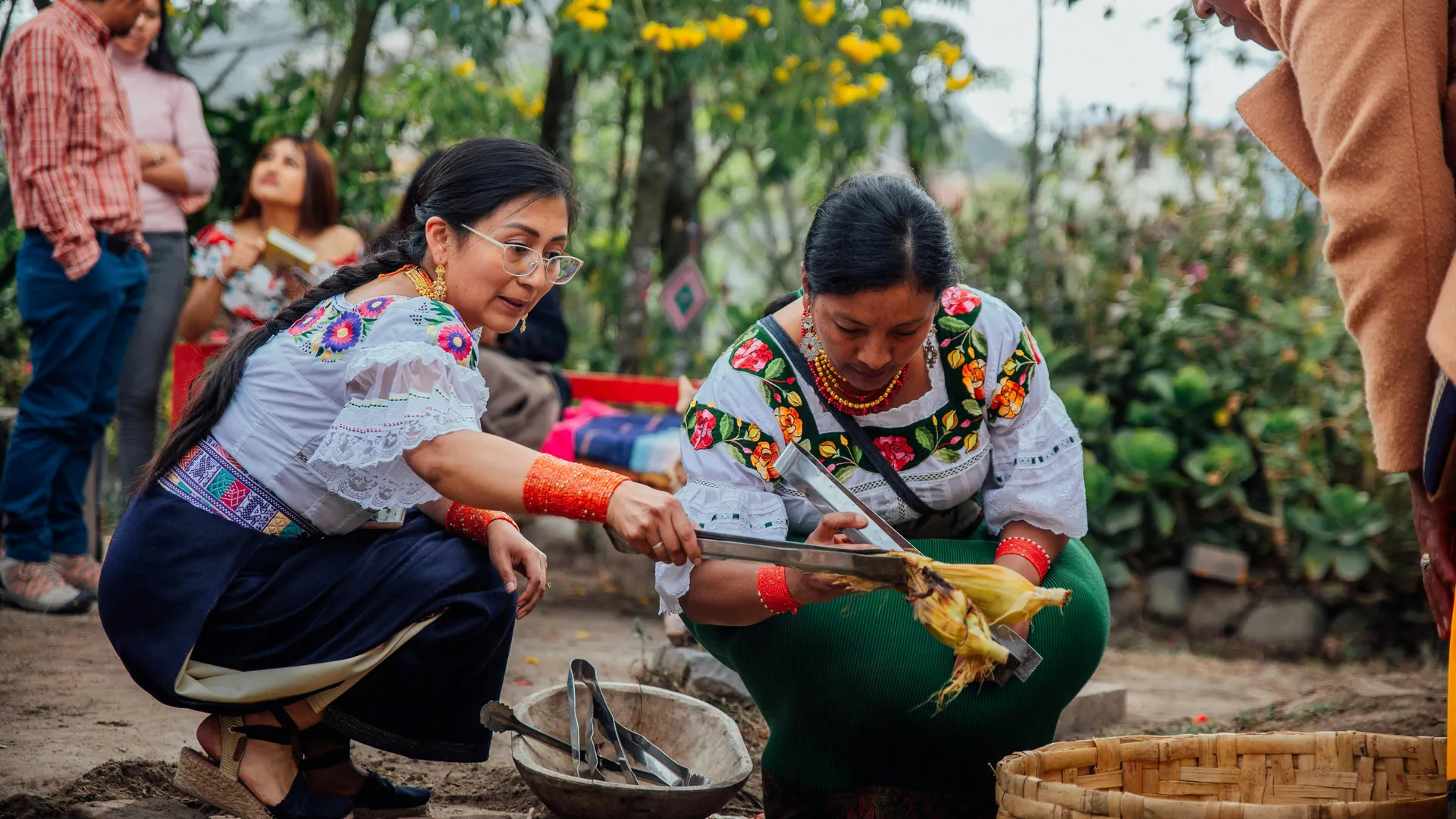
Timing your visit to the workshops requires understanding the local cultural calendar. During the Inti Raymi (Festival of the Sun) celebrations every June, local Kichwa weavers completely pause their production schedules. Instead of operating the looms, the artisans don their finest hand-woven white blouses, dark ponchos, and golden walcas (beaded necklaces). At midnight, the community descends to the Cascada de Peguche for ritual purification baths alongside local yachaks (shamans). To understand the deep historical and spiritual context behind these June celebrations, read our detailed post on Understanding the Andean Inti Raymi Traditions.
Travelers hoping to combine workshop visits with broader sightseeing can easily book a full-day Otavalo indigenous market and surrounding villages tour. These guided itineraries handle the complex logistics of navigating between the various rural communities, ensuring you arrive at the workshops when the master weavers are actively demonstrating their craft.
If you are planning an extended stay in the region, dedicating a full morning to exploring these artisan workshops provides a much deeper understanding of the local economy than a quick stop at the main market. Integrating Peguche’s weaving centers into your schedule is highly recommended. For a comprehensive day-by-day plan that includes the best times to visit the workshops alongside the area’s famous crater lakes, consult our 7-Day Imbabura Itinerary for Travelers.
Artisan Village Walking Map
Use the map below to navigate the artisan village pathways. Most of the prominent workshops, including Artesanía El Gran Cóndor and Peguche Wasi, are located within a 10-minute walk from the main waterfall entrance gate. The cobblestone roads are generally well-maintained, though comfortable walking shoes are highly recommended for the uphill trek toward Agato. For broader regional exploration, including crater lakes and leather towns in the Imbabura province, check out our Exploring Ecuador: Nearby Attractions guide.