Highland Market Shopping: Tips for Authentic Textiles
The Fabric of the Andes: Beyond the Souvenir
The Imbabura province is defined by its loom culture, a tradition so deeply entrenched in the local identity that the rhythm of the shuttle often dictates the pace of daily life. For the visitor standing in the center of the Plaza de Ponchos (officially Plaza Centenario), the sheer volume of textiles can be overwhelming. This market, designed in 1970 by Dutch architect Tonny Zwollo, features 90 concrete, umbrella-shaped stalls that serve as the commercial nucleus of the region. However, on Wednesdays and Saturdays—the peak fair days—commerce spills into the surrounding streets, where up to a third of the downtown area transforms into a labyrinth of wool, cotton, and acrylic.
Buying a textile here is not merely a transaction; it is an interaction with a dual history. You are navigating the intersection of the pre-Hispanic kallwa tradition and the colonial industrialization of the 16th century. For the conscientious traveler, the goal is to distinguish between mass-produced synthetic blends and the authentic cultural artifacts crafted by the local workshops and weavers of Peguche and Otavalo.
Deconstructing the Craft: A Tale of Two Looms
The Pre-Hispanic Backstrap
The oldest method practiced in the region uses the calluha (or kallwa in Kichwa). This backstrap loom requires the artisan to physically attach the device to their body using a belt. By leaning backward or forward, the weaver controls the tension of the warp. This method limits the width of the fabric to the span of the weaver’s reach, resulting in narrow, incredibly tight weaves used for belts (fajas) and intricate wall hangings. It is a slow, meditative process where the creator is literally part of the machine.
The Colonial Pedal Loom
In the 1500s, the Spanish introduced the wooden pedal shuttle loom to the Andes to fuel the production of the Obrajes (textile sweatshops). Today, this technology has been reclaimed by Peguche artisans to produce larger format items. If you are looking for a full-sized blanket, a heavy ruana, or a wall-covering tapestry, it was almost certainly created on a pedal loom. This method allows for greater speed and width, essential for the economic sustainability of many indigenous families.
Fiber Forensics: Real Alpaca vs. Synthetic Imitations
The most pervasive myth in the Andean markets is the label “100% Baby Alpaca.” In reality, a significant portion of the brightly colored, incredibly soft sweaters piled high on market tables are brushed acrylic—a plastic-based synthetic. True alpaca fiber is a protein, similar to human hair, while acrylic is a polymer. Identifying the difference is critical to justifying the price point and ensuring you are supporting genuine husbandry.
“Synthetic acrylic blends—frequently passed off as ‘baby alpaca’—will melt and burn rapidly, forming a hard bead and emitting a harsh chemical smell similar to burnt plastic.”
The Tactile Inspection
Before you even ask the price, use your hands. Master weavers in the Otavalo region often still use a puchkana (a traditional Andean drop spindle) to hand-spin wool. This manual process creates natural irregularities in the yarn thickness known as “slubs.” If the fiber is perfectly uniform, with zero deviation in thread thickness, it is likely machine-spun and potentially synthetic. Furthermore, real alpaca is cool to the touch, whereas acrylic tends to hold ambient heat.
The Definitive Burn Test
If you are purchasing a high-value item, ask the vendor for a small snippet of yarn from the interior seam. Most honest artisans will happily oblige. When lit with a flame, the reaction provides undeniable proof of the material’s origin.
| Feature | Authentic Alpaca (Protein) | Synthetic Acrylic (Plastic) |
|---|---|---|
| Burn Speed | burns slowly, may self-extinguish | Melts rapidly and flares up |
| Scent | Distinct smell of burnt hair | Harsh chemical or burnt plastic smell |
| Residue | Crisp, dark ash that crushes to powder | Hard, uncrushable black plastic bead |
Natural Dyes and Iconography
The vibrancy of Andean textiles is often achieved through natural chemistry. To produce rich, color-fast earthy browns, local artisans boil tocte (the green shell of the Andean walnut, or tukti kara). For the brilliant reds and purples seen in high-end tapestries, weavers use cochineal—tiny scale insects harvested from prickly pear cacti. While cochineal naturally yields a deep crimson, adding acidic modifiers like lemon juice shifts the hue to bright scarlet, whereas alkaline additives create rich purple tones.
When selecting a tapestry, look for the Chakana (Andean Cross). This 12-cornered stepped cross is not merely decorative; it represents the three realms of Andean cosmology: Hanan Pacha (the upper world), Kay Pacha (the earthly realm), and Uku Pacha (the underworld). Understanding these symbols connects you deeper to the Kichwa culture and the artisan’s intent.
Market Logistics and Transport
While the Plaza de Ponchos operates daily from 7:00 AM to 6:00 PM, serious buyers should arrive early on Wednesday or Saturday mornings. For those traveling independently, Cooperativa de Transportes Los Lagos has serviced the Imbabura province for over 60 years and remains the primary bus link between Ibarra, Otavalo, and Quito. More detailed arrival instructions can be found in our transportation guide.
For a historical perspective on the textile industry, visitors should consider a stop at the Hostería Hacienda Pinsaquí. Built in 1790, this estate originally operated as a massive textile workshop employing over 1,000 weavers, laying the groundwork for the region’s current economic focus.
Curated Textile Experiences
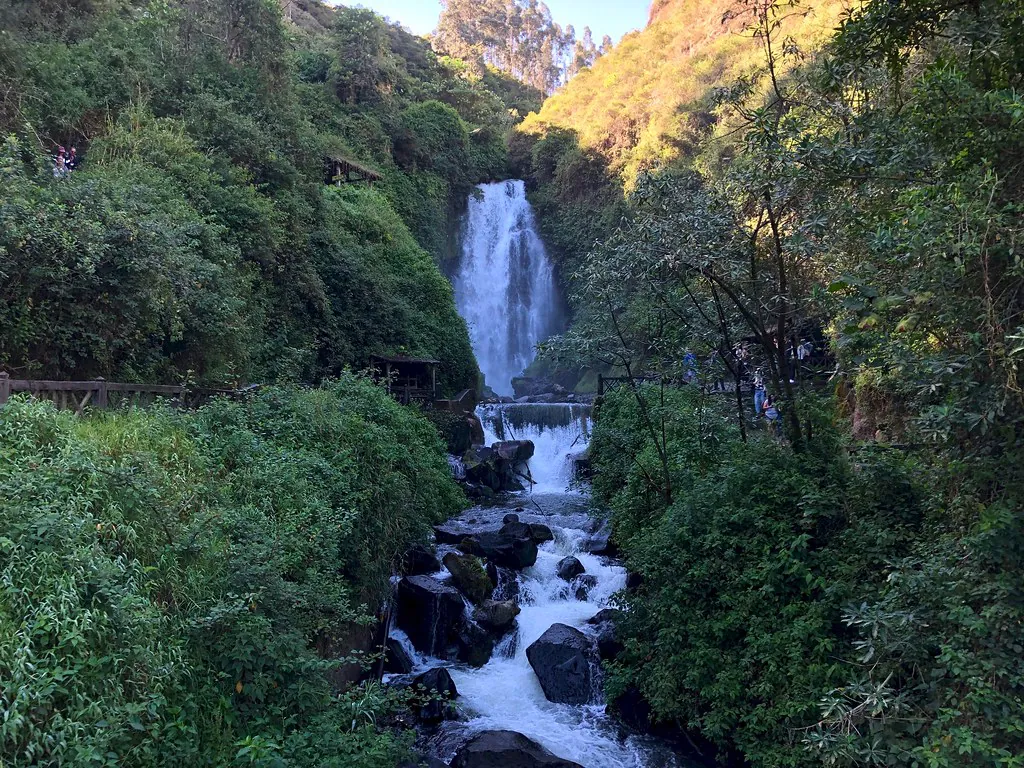
Navigating the market can be daunting without a local guide to translate Kichwa and verify quality. For a comprehensive introduction to the region, the Otavalo Tour from Quito covers the major indigenous markets and the surrounding province. If you prefer a more focused itinerary that includes the sacred waters nearby, the Private Tour of Otavalo Market and Peguche Waterfall offers a balanced mix of shopping and nature.
Travelers looking for a deeper dive into the geography that sustains these communities might opt for the Tour to Otavalo, Cotacachi, and Cuicocha, which connects the textile centers with the famous leather markets and crater lakes. For a personalized experience, the Full Day Otavalo Indigenous Market tour provides a dedicated guide to help you distinguish authentic artisan goods from commercial stalls. You can check current ticket and tour availability for these excursions directly through our partner providers.
Always remember that the communities surrounding these markets, such as the Otavalo Municipality and the nearby artisan villages, rely on informed tourism to keep their traditions alive. By asking the right questions and respecting the craft, you become a guardian of this Andean heritage.