I. REGIONAL CONTEXT: The Imbabura Hub
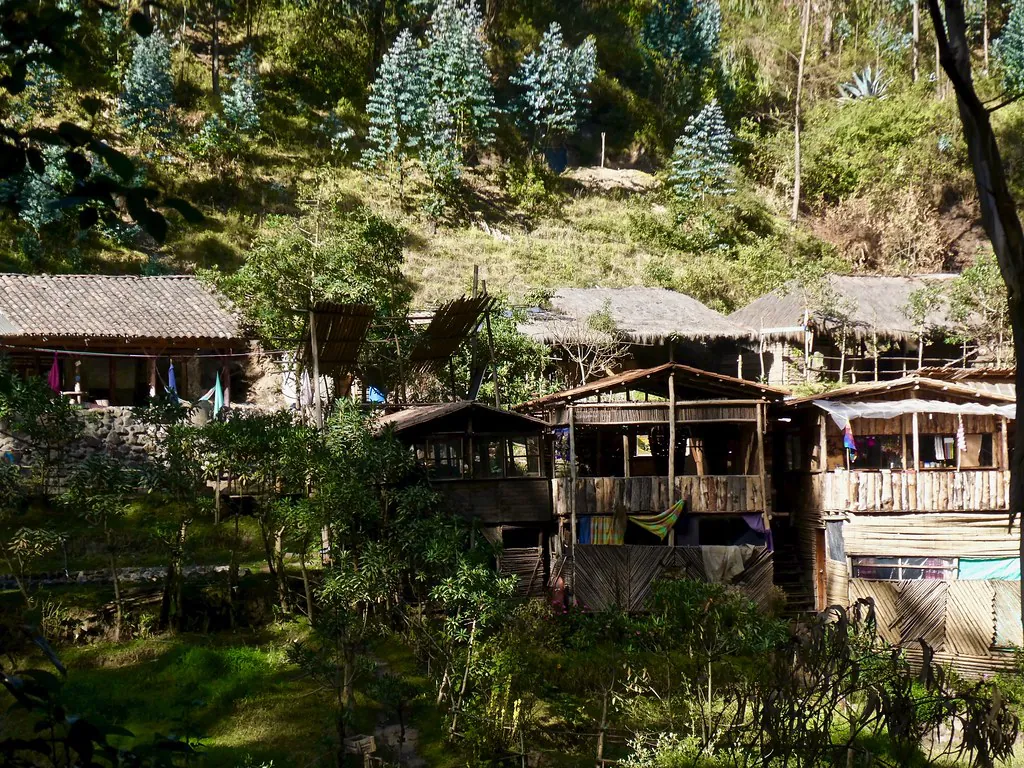
Strategic travelers treat Cascada de Peguche as the primary geographical anchor for northern Ecuador, utilizing the immediate surrounding area for continuous basecamp tourism. By establishing a central hub near the protected forest, visitors position themselves within a 30-minute transit radius of the Imbabura province’s most significant cultural and ecological sites. This centralized approach eliminates the exhausting daily commute from the capital along Highway E35. Travelers can easily acclimate to the 2,500-meter elevation while securing early morning access to high-altitude crater lakes and indigenous markets before the afternoon fog rolls across the Andean valleys.
Regional exploration requires careful timing and an understanding of local transit rhythms. The Imbabura province operates on an early schedule, driven by the agricultural and commercial routines of the local communities. To fully leverage your position in the northern highlands, we recommend integrating these regional extensions into A 7-Day Imbabura Itinerary for Travelers. Expanding your timeline allows for meaningful engagement with the region’s complex history, directing focus toward authentic daily life rather than superficial observation. Understanding the local context also enhances the appreciation of the sacred landscapes, a concept further detailed in our guide to Kichwa Culture & The Inti Raymi Festival.
Top Nearby Spots Comparison
| Destination | Distance from Peguche | Standard Transport Mode | Estimated Transit Cost |
|---|---|---|---|
| Parque Cóndor | 6.5 Kilometers | Direct Local Taxi | $4.00 – $5.00 |
| Museo Viviente Otavalango | 4.2 Kilometers | Walking / Taxi | $0.00 – $3.00 |
| Cuicocha Crater Lake | 22 Kilometers | Bus to Cotacachi + Taxi | $5.40 total (one-way) |
| El Lechero Viewpoint | 5.8 Kilometers | Hiking / 4×4 Taxi | $0.00 – $6.00 |
| Intiñán Solar Museum | 85 Kilometers | Interprovincial Bus | $2.50 – $4.00 |
| Tulcán Cemetery | 115 Kilometers | Northern Route Bus | $4.00 – $6.00 |
II. TOP-RATED SELECTIONS (4.7+ Ratings)
Parque Cóndor
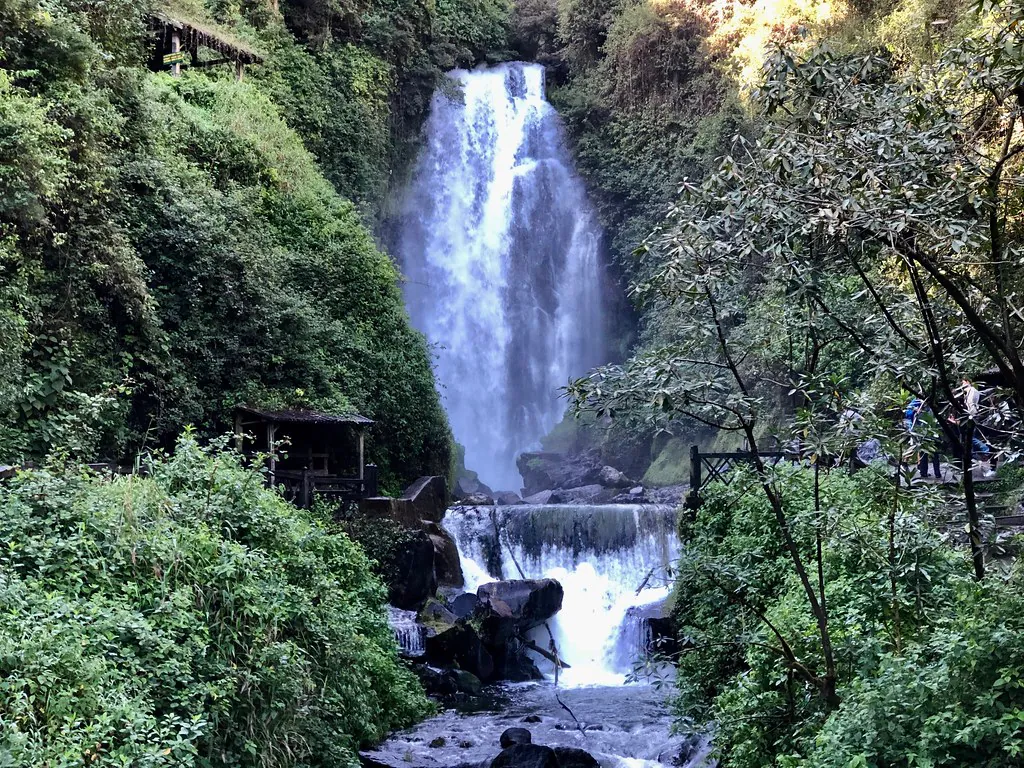
Perched high above the valley on the Pucará Alto hill, Parque Cóndor operates as a premier avian rescue and rehabilitation center boasting a consistent 4.8 visitor rating. As of 2026, general admission remains highly accessible at $6.00 for adults and $3.00 for children between the ages of 3 and 11, as well as for disabled visitors. The facility enforces a strict Wednesday to Sunday schedule, opening its gates from 9:30 AM to 5:00 PM. This schedule allows guests ample time to examine the expansive enclosures housing rescued Andean condors, owls, and harpy eagles. The center focuses entirely on rehabilitation and education, providing detailed biological profiles for each rescued bird while generating crucial funding for ongoing habitat protection initiatives across the high Andes. Additional details on their conservation metrics are documented on the Parque Cóndor Official Website.
The absolute highlight of any visit to the park is the famous free-flight demonstration, occurring twice daily at 11:30 AM and 3:30 PM, strictly weather permitting. During these sessions, visitors gather at an outdoor stone amphitheater offering sweeping, unobstructed views of the Imbabura and Cotacachi volcanoes. Expert falconers release rehabilitated raptors into the thermal currents rising from the valley floor, demonstrating their natural hunting and gliding behaviors. The altitude and exposed positioning of the amphitheater mean winds can be intense, requiring visitors to bring heavy windbreakers even on clear days. Arriving at least thirty minutes prior to the demonstration ensures a seat on the lower stone tiers, which provide the best vantage points for wildlife photography.
Museo Viviente Otavalango
Located at Vía Antigua a Quiroga #1230, approximately five minutes from the commercial center of Otavalo, the Museo Viviente Otavalango charges a standard $5.00 admission fee for international visitors. The museum occupies the historic 1821 San Pedro textile factory, a massive industrial complex that historically utilized exploitative labor practices against the indigenous population. In a profound historical correction, a coalition of 20 Kichwa families successfully reclaimed the property in 2011 to preserve and protect their ancestral heritage. The site now functions as an interactive educational center where visitors interact directly with community elders, examining traditional agricultural techniques, textile production, and ancestral medicinal practices. Visitors looking to purchase authentic textiles after their museum tour should reference our guide on Local Workshops & Weavers.
Unlike static historical exhibitions, Otavalango relies entirely on live demonstrations and oral histories presented by the families who manage the cooperative. Guides walk visitors through the original brick corridors of the factory, contrasting the harsh realities of the 19th-century industrial era with the modern cultural resurgence of the Kichwa people. You will witness live demonstrations of backstrap loom weaving, wool spinning, and the preparation of ceremonial foods. The museum strictly prohibits unauthorized photography during specific spiritual demonstrations, requiring visitors to explicitly ask their guide before capturing images of the elders at work. Revenue generated from the $5.00 entry fee directly supports the 20 families, funding the structural maintenance of the 200-year-old factory buildings and the Otavalango Community Foundation.
Cuicocha Crater Lake
Positioned inside the massive Cotacachi-Cayapas Ecological Reserve, Cuicocha Crater Lake requires a brief, multi-leg transit from the Peguche hub. To reach the Guinea Pig Lake independently in 2026, visitors must first board a green local bus heading toward Cotacachi or Quiroga, costing between $0.35 and $0.40 per passenger. From the Quiroga drop-off point, a direct $5.00 taxi ride transports travelers straight to the reserve’s main entrance checkpoint. Under current Ecuadorian Ministry of Tourism regulations, admission to the ecological reserve is completely free, though visitors must register their passport or Ecuadorian cédula with the park rangers upon arrival. Alternatively, travelers can simplify the logistics by booking a comprehensive private tour of Otavalo, Cuicocha Lake, and Peguche, which bundles regional transit into a single itinerary.
The caldera formed roughly 3,000 years ago following a massive phreatomagmatic eruption, leaving behind a highly alkaline, deep blue lake measuring over three kilometers across. Two steep, forest-covered islands, Teodoro Wolf and Yerovi, rise dramatically from the center of the water. While hiking the challenging 14-kilometer rim trail takes approximately four to five hours and offers spectacular high-altitude panoramas, less active visitors can opt for a 25-minute motorized boat ride around the islands for $3.50. The boats navigate closely to the volcanic vents bubbling beneath the surface, providing a stark reminder of the active geothermal forces shaping the Imbabura landscape.
El Lechero Sacred Viewpoint
Situated 2,847 meters above sea level on the prominent Pucará de Rey Loma hill, the El Lechero sacred viewpoint provides arguably the most critical geographic perspective of the Imbabura province. The site centers around the revered remnants of a single, ancient Lechero tree that stood in stark isolation against the Andean sky before falling in 2020. Reaching the summit requires a steep, 45-minute uphill hike from the shores of San Pablo Lake, or a quick $5.00 taxi ride from the central market blocks of Otavalo. The physical elevation yields an uninterrupted, 360-degree panoramic view that perfectly frames the Imbabura Volcano, the sprawling waters of San Pablo Lake, and the distant peaks of the Cotacachi summit. Photographers should plan their arrival for the early morning hours, specifically between 6:30 AM and 8:00 AM, to secure clear sightlines before the predictable afternoon cloud cover advances.
Beyond its topographical value, El Lechero functions as an active spiritual epicenter for the indigenous communities of the northern highlands. The tree itself is believed to possess profound healing properties and serves as a primary site for ritual purification and agricultural offerings. During periods of drought, local shamans ascend Pucará de Rey Loma to perform specific rain-summoning ceremonies at the base of the trunk. Out of respect for these ongoing practices, visitors must maintain a quiet, observant demeanor while on the summit and absolutely refrain from touching, climbing, or leaving unauthorized items on the tree’s remains or surrounding saplings. Understanding the gravity of this location is essential; we highly encourage reading our breakdown of Understanding the Andean Inti Raymi Traditions prior to visiting the hilltop.
Tulcán Cemetery
For travelers willing to extend their northern route toward the Colombian border, the officially renamed José María Azael Franco Guerrero Municipal Cemetery in Tulcán represents a masterpiece of landscape architecture. Located approximately 148 kilometers north of the Peguche hub, the grounds span eight meticulously manicured hectares. Interprovincial buses depart frequently from the Otavalo terminal, taking nearly three hours to reach the border city at a cost of $4.00 to $6.00 per ticket. The cemetery completely redefines traditional burial grounds by featuring over 300 giant cypress topiaries, each painstakingly carved into massive, intricate shapes. Admission to the municipal grounds is entirely free, and the site remains open daily from 6:00 AM until 8:00 PM (closing at 6:00 PM on Sundays), heavily monitored by local municipal guards.
The topiary project began in 1936 under the direction of José María Azael Franco, who capitalized on the highly calciferous soils that allowed the local cypress trees to grow in incredibly dense, shapeable formations. Today, a dedicated team of municipal gardeners maintains the sprawling green sculptures, which depict a complex mix of Incan gods, geometric arches, classical Roman figures, and native Andean fauna. Navigating the towering green corridors feels distinctly maze-like, requiring at least 90 minutes to fully explore the distinct sections of the park. Because Tulcán sits at an elevation of nearly 3,000 meters, the climate is noticeably colder and wetter than the Imbabura valleys, mandating heavy jackets and waterproof footwear for all visitors.
Intiñán Solar Museum
While physically located two hours south of the Imbabura province in the Pichincha region, the Intiñán Solar Museum serves as a mandatory stop for travelers routing their transit between Quito and the northern highlands. Situated about 200 meters from the massive, official Mitad del Mundo monument, this interactive, open-air museum costs $4.00 to $5.00 for adults and $2.00 for children. While the museum claims that GPS calculations place the Intiñán property precisely on the actual equatorial line, independent readings show it is actually slightly off the true 0°0’0″ mark, much like its larger, state-sponsored neighbor. The museum divides its focus equally between indigenous Amazonian anthropology, featuring a genuine tzantza, and interactive physical science exhibits. For official operating hours, travelers should consult the Museo Intiñán Portal.
The museum’s primary draw revolves around a series of hands-on physical demonstrations attempting to showcase the unique gravitational and rotational forces present at exactly zero degrees latitude. Guides actively instruct visitors to balance raw eggs on the heads of nails, walk a straight line with their eyes closed to test equilibrium, and observe water draining straight down a basin without any visible Coriolis vortex. While these small-scale demonstrations are widely debunked as parlor tricks rather than strict science, the interactive nature of the tour provides high-quality entertainment and distinct photographic opportunities. If you are coordinating transport from the capital up to Peguche, integrating this equatorial stop breaks up the long drive perfectly; review our guide on How to get to Cascada de Peguche for specific highway routing.
Getting Around the Region
Public Transit
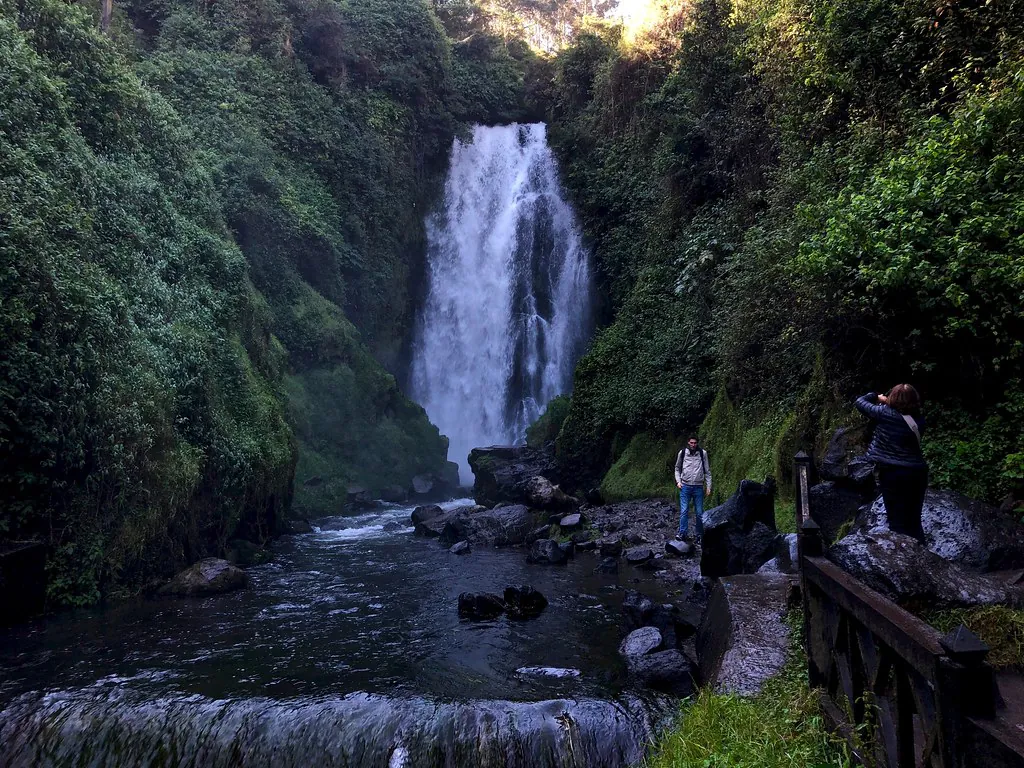
The Imbabura province relies heavily on an efficient, highly affordable network of local buses and regional taxi cooperatives. The central bus terminal in Otavalo functions as the primary distribution hub for the entire region. Green and blue buses depart every 15 minutes toward Cotacachi, Quiroga, and Ibarra, rarely costing more than $0.65 per segment. For hyper-local transit, specifically the routes connecting the artisan villages around Cascada de Peguche, yellow taxis operate on standard, unmetered zone rates. A standard ride from the Otavalo terminal to the protected forest entrance costs $2.50 to $3.00. Always confirm the exact fare with the driver before loading your luggage into the vehicle. For a broader overview on securing your belongings while using regional transit, please consult our guide: Is Northern Ecuador Safe for Tourists?
Private Transit & Guided Options
While public buses offer profound economic advantages, they significantly limit the number of sites you can visit within a single 12-hour window. Travelers operating on tight schedules or those who prefer avoiding the complexities of regional bus transfers often rely on dedicated transport. Booking a full-day private tour of Otavalo and its surroundings guarantees exclusive vehicle access, allowing for rapid transit between Lago San Pablo, the artisan workshops, and the Cascada de Peguche. Private drivers possess distinct knowledge of the complex, unmarked dirt roads traversing the Imbabura hillsides, entirely removing the risk of navigational errors. If you prefer evaluating different excursion lengths or combined ticketing options, be sure to review our comprehensive Tickets & Tours breakdown.